Future one · Extraction
AI gets more out of people.
The recovered time disappears into more output, more administration, and more pressure. The tools get stronger. The people do not.
44 free, copy-ready prompts for restaurant, retail, hospitality, and franchise managers. Use AI to remove low-value work, strengthen your judgment, and put the time back into coaching, recognizing, and developing your people.
From Jon Harmeling, Chick-fil-A Operator leading about 90 team members, West Point graduate, and author of Frontline AI Leadership. Machines do. Managers decide. Leaders develop.
Welcome, reader.
This is the living companion to Frontline AI Leadership. Jump to your chapter, or start with the Human Reinvestment Prompt.
Before you paste anything into an AI tool, use the Frontline AI Data Rule from Chapter 10. Confirm the tool and the use are approved, give AI the minimum it needs, and use roles or initials instead of names.
Green: Go within approved use.
Public, fictional, sanitized, or generic material, or information clearly authorized for this tool and purpose. Use only what the task needs and review the output.
Yellow: Pause and check.
Internal documents, employee situations, schedules, unpublished plans, and operating data. Confirm approval, remove names and unnecessary detail, and narrow the excerpt. Otherwise, keep it out of the tool.
Red: Stop in an unapproved system.
Credentials, payment information, health information, sensitive HR records, confidential guest data, work-authorization documents, and security details. Use a specifically authorized workflow or escalate.
Green moves. Yellow verifies. Red stops and escalates.
Use AI to:
Do not use AI to:
Use your organization's approved tools and policies. Do not let AI make consequential employment decisions. You own the decision, the consequence, and the relationship.
Each prompt is a template. Replace anything in [brackets] with your situation.
Write "a new cashier" or "J.R.," not a full name. Leave out health, pay, discipline, and guest details.
Separate facts from assumptions before you act. AI recommends. Managers decide.
The prompt prepares you. The conversation, the decision, and the follow-through are yours.
Works in ChatGPT, Claude, Gemini, Copilot, or whatever tool your organization has approved.
The recovered time disappears into more output, more administration, and more pressure. The tools get stronger. The people do not.
Leaders deliberately reinvest part of that time in coaching, recognition, opportunity, and development. The tool does not decide which future you get. Leadership does.
AI can create capacity. Management decides how that capacity is used.
Human Reinvestment is not an intention. It is an allocation.
Use when: Once a week, before the schedule fills itself.
I lead [team or role, e.g., a 90-person restaurant team]. My priorities this week: [list]. Where my time went last week, by task and rough hours: [list]. The people I am responsible for developing, by role or initials: [list]. 1) Name the 3 tasks AI could most realistically remove, shorten, or prepare, and estimate the usable time left after review and correction. 2) Suggest where to reinvest that time: one coaching conversation, one recognition, and one stretch opportunity. 3) Help me put each one on my calendar with a date. Do not do the human part for me. Help me prepare to do it better.
Data check: Roles or initials only. No health, pay, or discipline details. The Human Reinvestment Flywheel Book: Ch. 12
14 prompts for the moments that fill a frontline manager's week: handoffs, call-outs, new hires, coaching, guest recovery, recognition, and the alerts that hide a human story.
Use when: The last ten minutes of your shift.
Here are my rough notes from today's shift: [paste notes with team member names replaced by roles or initials and guest details removed]. Turn them into a 60-second handoff for the next manager: 1) what is still open and who owns it, 2) the top 3 risks for the next shift (staffing, equipment, low inventory, large orders), 3) anything a person must verify in person, and 4) one team member who deserves a thank-you and why. Keep it under 120 words.
Data check: No guest names or contact details. No health reasons for absences. Book: Ch. 5, 6
Use when: Before a busy daypart.
Plan a 5-minute pre-shift huddle for [daypart] given: forecast [busy or normal], focus area [e.g., order accuracy, drive-thru times, catering], and new team members on shift [number]. Give me one opening line, one standard to reinforce with a real example, one question for the team, and one way to recognize someone specifically. Make it sound like me talking, not a memo.
Data check: Green. No personal information needed. Book: Ch. 13, 16
Use when: When people call out and the shift still has to run.
Two people called out for [shift]. Here is who is available, by initials and position, with their hours this week: [list]. Our rules: [minors' hours, maximum hours, breaks, overtime approval]. Give me 2 or 3 coverage options with the tradeoffs: overtime, fatigue, skill coverage, and fairness. Flag anything I must verify with payroll or local labor law. Then remind me who to thank, and who may need a check-in rather than a schedule fix. I make the final call.
Data check: Leave out the reason for a call-out if it is medical or family-related. Book: Ch. 9, 10, 12
Use when: Before a new team member's first shift.
Design the first week for a new [position] starting [date]. Separate it into what can be automated (forms, reminders, training modules, schedule notices), what a trainer does, and what I must do personally, including a one-on-one welcome meeting. For my welcome, give me 3 questions to learn who they are and one sentence explaining what we value here.
Data check: Red: never put work-authorization documents, Social Security numbers, or IDs into a general AI tool. Book: Ch. 4, 10
Use when: When someone has been struggling for more than a shift or two.
A team member in [position, time in role] has been struggling with [observable behavior, e.g., missing ticket times on the grill during lunch] for [how long]. What I have seen directly: [facts]. Help me prepare, not script: separate facts from my assumptions, give me 3 questions to understand what is getting in the way, one clear expectation in plain language, and one specific support I can offer. Then role-play their likely first reaction so I can practice staying calm and clear.
Data check: Describe behavior, not the person. No names or health details. Book: Ch. 13
Use when: After a complaint or a low-star review.
A guest complaint: [paste it with name, phone, email, and order number removed]. Verified facts: [list]. What I can offer within policy: [options]. Still uncertain: [list]. Draft a short, non-defensive response that sounds like a real local leader, does not admit to anything we have not verified, and states the next step. Then give me an internal list: what to fix in the operation, who owns it, and whether any team member needs coaching or deserves recognition. Flag anything involving allergies, food safety, injury, or discrimination for escalation instead of a reply.
Data check: Red: confidential guest data stays out. Remove names and contact details first. Anatomy of an AI Workflow Book: Ch. 6
Use when: When you notice someone doing it right.
Here is something I noticed this week: [behavior, situation, who it helped]. Help me make the recognition specific: the exact behavior, why it mattered to guests or teammates, and how to say it in front of the team in under 30 seconds. Also suggest one follow-up question to ask privately. Do not make it sound like a template, and do not guess at their feelings.
Data check: Green. Initials are enough. Book: Ch. 12, 16
Use when: When a report flags overtime, labor variance, or a late clock-in.
My system flagged this: [e.g., overtime on Tuesday, a labor-cost variance, a late clock-in], with no names. Before I treat it as a cost problem, help me ask what human story might sit behind it. Give me 3 questions to find out what actually happened, who might need support, and who might deserve recognition. Remind me to confirm the facts with people, not just the report.
Data check: Describe the alert, not the person. Never paste payroll records. Book: Ch. 12
Use when: Before you address a pattern of call-outs or tardiness.
I need to talk with a team member about [attendance or tardiness pattern: dates and facts only]. Help me prepare a conversation where the feedback is actually received and understood: an opening that is direct and respectful, the specific facts, the expectation, a question that invites their side, and how I will confirm they understood. Remind me that I make any disciplinary decision and that I follow our documented policy.
Data check: Leave out medical or family reasons. Those stay in person and in the approved HR process. Book: Ch. 11
Use when: Before someone runs their first shift.
I am considering giving [role or initials] their first [opening, closing, or drive-thru lead] shift. Based on what I have observed: [list], what should I verify before giving independent authority? Suggest a supervised practice shift, the boundaries and escalation rules, 3 coaching questions for the debrief, and how I will recognize their growth with specific evidence.
Data check: Observed behavior only. No HR records. Book: Ch. 15
Use when: Right after AI takes a task off your plate.
AI just gave me back [number] hours a week from [task]. Before those hours disappear into more administration, help me decide where they go. Give me 3 specific reinvestments in people (who by role, what kind of time, how often) and one way to check in 30 days whether the time actually reached them.
Data check: Green. Roles only. The Capacity Dividend Book: Ch. 3, 12
Use when: Before your team starts using AI tools on its own.
Help me write a one-page "how we use AI here" guide for my frontline team at [type of business]. Include: approved tools, what never goes into AI (guest information, payment data, other team members' personal details), when to ask a manager first, how to double-check AI answers, and what we will always do in person. Keep it at an 8th-grade reading level and short enough to post in the break room.
Data check: Have the result reviewed against your organization's actual policy. The Frontline AI Data Rule Book: Ch. 10, 17
Use when: Before you change a workflow your team depends on.
I want to introduce AI to my team in a 10-minute meeting without causing fear. Given [team type, current tools, the one workflow we are changing], help me explain what is changing, what is not, what AI will and will not do, how it gives time back to people, and how anyone can raise a concern. Include 3 questions to ask the team and one commitment I will make to them.
Data check: Green. No personal information needed. Book: Ch. 17
Use when: When you are doing work someone else could learn to own.
Management keeps work running; leadership grows people. Here is my week: [list of tasks I personally handle]. What am I doing that a capable team member could own with the right preparation? Help me pick one person (role or initials) and one capability, and give me the stretch responsibility, the boundaries, and the follow-up date to schedule before the conversation ends.
Data check: Roles or initials only. Book: Ch. 2
In the Frontline AI Leadership keynote, Jon shows these tools in action with real stories from running a restaurant, and every attendee leaves with a plan: one person to develop, one conversation to prepare, one commitment with a date. The Field Guide is their free takeaway.
15% off when two or more paid events are booked together. A 30-minute preparation call and audience-specific customization are included. One 30-minute virtual follow-up within 60 days of the event is included in both standard paid in-person and virtual keynotes.
Remove the right work so people have more capacity for judgment, guests, development, and leadership.
Use when: When the admin is eating your shifts.
Here are the recurring tasks that fill my shifts and my week, with rough minutes for each: [list, e.g., schedule changes, prep lists, review responses, training checklists, inventory counts]. For each, ask first whether it should exist at all, then whether it can be simplified or standardized before anything is automated. Rank the 5 best candidates for AI help, say what a person must still check, and name one block of time I should protect for leading people instead.
Data check: Describe tasks, not people. Book: Ch. 1, 5
Use when: Before you claim AI is saving you time.
For this AI-assisted task: [task, current minutes per week], estimate the real Capacity Dividend. Start with the claimed time saved, then subtract the time for prompting, reviewing, verifying, correcting, handling exceptions, maintaining the workflow, and recovering from failures. Show your math, label estimates, and tell me the usable minutes left. Then ask me where those minutes will go and who they will reach.
Data check: Green. Describe the task only. The Capacity Dividend Book: Ch. 3
Use when: When a prompt works and you want it to work every time.
Turn this recurring process into a responsible AI workflow: [process, e.g., responding to 1 to 3 star reviews]. Map it using seven elements: Trigger, Inputs, Machine work, Human judgment, Action, Exception, and Measure and improve. For each element, say who owns it, what information the machine actually needs (and what it should never see), and what happens when the output is wrong.
Data check: Yellow: design the workflow with sample or sanitized data first. Anatomy of an AI Workflow Book: Ch. 6
Use when: Before you automate any responsibility.
Break this responsibility into its steps: [responsibility, e.g., onboarding a new team member]. Place each step in one of four categories: Human Only, Human + AI, AI + Human Review, or Safe to Automate. Explain why each boundary exists. Flag any step where human presence is the point (a welcome, an apology, recognition) and keep it human.
Data check: Green. Describe the steps, not the people. The Human + AI Work Matrix Book: Ch. 4
Use when: Before and after you add AI to a process.
Help me build a one-page before-and-after scorecard for this AI-assisted process: [process]. Use the same unit before and after (minutes, errors, cycle time, guest or team impact). Label every number as measured, estimated, or unknown. List the claims I can support, the claims I cannot, and the specific place any usable capacity went.
Data check: Use totals, not individual employee data. The Capacity Dividend Book: Ch. 7
AI recommends. Managers still own context, boundaries, judgment, and consequences.
Use when: When you are already sure.
Here is the decision I am considering: [decision and my reasoning]. Argue against my current position. Identify assumptions I may be making, information I may be missing, people who may experience unintended consequences, and what evidence should change my mind.
Data check: Describe affected people by role. Book: Ch. 8
Use when: When an AI recommendation looks right on paper.
Here is an AI recommendation: [paste]. Make three columns: what the system knows, what I know from the floor, and what neither of us knows. Mark each decision-relevant item as verified, unverified, or unknown. Then tell me the one unknown I should reduce by talking to a person or watching the work before I act.
Data check: Green or Yellow depending on the recommendation. Remove names. Book: Ch. 9
Use when: Before a change you cannot easily undo.
Assume this decision produces a bad outcome six months from now: [decision, e.g., a new labor model or a drive-thru process change]. Give me the five most plausible reasons why, the warning signs I should watch for, and what I should investigate before proceeding.
Data check: Green. Describe the decision, not individuals. Book: Ch. 8
Use when: Before you paste anything into an AI tool.
Before I use AI for this task: [the task, the tool, and a description of the information I plan to include], classify each piece of information as Green (public, fictional, sanitized, or approved for this tool), Yellow (internal documents, employee situations, schedules, operating data: pause and check approval), or Red (credentials, payment data, health information, sensitive HR records, confidential guest data: stop and escalate). Tell me what to remove, how to sanitize the rest, and whether this task should stay outside the tool. Do not ask me to paste anything Red.
Data check: Run this on a description of the data, not the data itself. The Frontline AI Data Rule Book: Ch. 10
Use when: Before you act on any AI answer that matters.
Audit this AI output: [paste]. Separate it into facts, assumptions, interpretations, and recommendations. For each fact, tell me how I could verify it. Show me where the answer sounds more confident than its evidence, and what I would need to see before I decide.
Data check: Check the output for names or personal details before pasting it anywhere else. The Judgment Gap Book: Ch. 8
Use when: When AI, or an AI agent, is part of a decision.
For this AI-assisted decision or workflow: [describe it], map the Responsibility Chain: who or what produces the output, who verifies it, who decides, and who owns the consequences afterward. If an AI agent can take actions, define its access, required approvals, reversibility, escalation path, and monitoring. Flag any place where someone has responsibility without authority, or authority without responsibility.
Data check: Green. Use roles, not names. The Responsibility Chain Book: Ch. 11
The 90-minute leadership team session and the half-day workshop turn this guide into your managers' own workflows, data rules, and development plans, using your tools and your policies.
15% off when two or more paid events are booked together.
Leaders develop people, and they develop themselves. AI can increase both the capacity and the capability to do that work well.
The goal is not merely to save time. It is to turn saved time into stronger people.
Use AI to prepare for better conversations, not to replace them.
Use when: The night before a one-on-one.
Help me prepare for a one-on-one with [role or initials, time in role] that develops the person, not just their performance. Context I can share: [goals, recent wins, current challenge, without health or HR details]. Give me three questions that will help them think, one strength I should recognize, one issue I may be avoiding, and one question I should ask rather than answer.
Data check: Role or initials only. Leave sensitive context out. Book: Ch. 13
Use when: When someone brings you a problem you could fix in 30 seconds.
A team member brought me this problem: [problem]. Help me resist solving it for them. Give me five coaching questions that could help them diagnose the issue, generate options, weigh tradeoffs, and own the next step.
Data check: Green. Describe the problem, not the person. Book: Ch. 13, 15
Use when: When someone is ready for more.
Based on the strengths, responsibilities, goals, and observed behaviors I provide: [list, role or initials only], what growth opportunity could stretch this person without setting them up to fail? Suggest one real assignment and three coaching questions.
Data check: Observed behavior only. Book: Ch. 15
Practice before the human moment arrives.
Use when: Before a conversation you are dreading.
I need to have this difficult conversation: [situation, described without names or health details]. Role-play the other person and push back realistically so I can practice responding with clarity, empathy, and accountability. After the role-play, critique my approach and point out where I became defensive, vague, harsh, or avoidant.
Data check: Fictionalize the details. The practice works without real names. Book: Ch. 13
Use when: When you are sure you know why someone did it.
Before I have this conversation, separate the facts I actually know from the story I may be telling myself about the other person's motives. Here is what happened: [facts and my interpretation]. Then give me three neutral questions that could help me learn what I do not know.
Data check: Green or Yellow. Remove names. The Judgment Gap Book: Ch. 8, 13
Let AI help you notice. Let the human do the caring.
Use when: When you want praise to mean something.
I want to recognize a team member myself. Here is what I saw: [specific behavior, when it happened, who it helped]. Help me name the exact behavior, why it mattered to the team or our guests, and one question I can ask afterward to make it a real conversation. Do not write a speech for me, and do not guess how they feel. Keep it short enough to say in person on the floor.
Data check: Green. Initials are enough. Book: Ch. 12, 16
Use AI to help people become more capable, not more dependent.
Use when: When a team member wants to grow into leadership.
A team member [role, time in role] wants to grow toward [trainer or shift leader]. Strengths I have observed: [list]. Gaps: [list]. Build a 90-day plan around one capability at a time: a real stretch responsibility on actual shifts, the boundaries, what I will verify before giving independent authority, coaching questions, and review dates scheduled before the work begins. No classroom-only steps.
Data check: Observed behavior only. No HR records. Book: Ch. 14, 15
Use when: When too much depends on you, or on one tool.
Imagine I am unavailable for 30 days. Then imagine our main AI tool is unavailable for the same 30 days. For [process or decision, e.g., weekly scheduling or catering orders], what would stop, what knowledge lives only in my head or in the tool, and who else could act with the right preparation? Turn the gaps into a plan that gives one more person a bounded opportunity to lead.
Data check: Green. Describe the process. Book: Ch. 16
Build the trust, judgment, and bench strength no tool can.
Use when: When the same problem keeps coming back.
Here are the recurring team challenges I am seeing: [e.g., drive-thru times slipping on weekends, repeated handoff misses]. Help me determine whether the underlying issue appears to involve clarity, capability, accountability, trust, communication, role design, or process. Do not jump to a solution. Give me questions I should ask the team first.
Data check: Green. Describe patterns, not individuals. Book: Ch. 16
Use when: When the team needs to solve it together.
Help me design a 30-minute team discussion around this issue: [issue]. Give me an opening question, three questions that surface different perspectives, one way to keep the loudest voice from dominating, and a concrete closing commitment with an owner and a date.
Data check: Green. Book: Ch. 16, 17
Use AI as a mirror and a practice field, not a psychologist.
Use when: At the end of a hard week.
Based on these situations from my week: [list], identify patterns in how I led. Where might I be avoiding conflict, over-directing, failing to delegate, solving problems my team should learn to solve, confusing activity with leadership, or confusing a thoughtful response with completed follow-through?
Data check: Describe situations by role, not name. Book: Ch. 14
Use when: When your first instinct is to reject feedback.
I received this feedback: [feedback], and my first instinct is to reject it. Help me separate legitimate disagreement from defensiveness. Ask me five questions before giving me any conclusions.
Data check: Green. Book: Ch. 14
Use when: Within a day of an important interaction.
Run a five-minute after-action review of this leadership moment: [describe it]. What did I intend? What happened? What assumptions did I make? What did the other person likely experience, based only on the evidence I have given? Then help me choose one observable behavior to practice for 90 days, with a trigger, the practice, and the evidence I will look for.
Data check: Role or initials only. Book: Ch. 14
Use when: Ten minutes at the end of every week.
Here are this week's leadership moments and my commitments to people (roles or initials): [list]. In under 200 words, show me where I managed work versus developed people, one human moment I handled well, one I avoided, and which commitments are done, open, or unknown. Do not count a plan or a message as a completed action. Name one behavior to practice next week.
Data check: Roles or initials only. Book: Ch. 12, 14
Human Reinvestment is not an intention. It is an allocation.
Use when: When the busiest weeks crowd out the quiet people.
Here is my team by role or initials, with a rough note from my own memory on when I last had a real conversation with each: [list]. Who have I invested in least lately, and who might be at an important moment (a new role, a struggle, a milestone)? Treat everything as a hypothesis for me to check in person. Suggest one open question to start each conversation.
Data check: Do not paste chat logs, attendance records, or HR notes. The Human Reinvestment Flywheel Book: Ch. 12
Use when: When a team member shares a goal bigger than this job.
One of my team members has shared a goal outside this job: [goal type, e.g., finishing a degree, citizenship, military service, a career change]. Give me 5 questions to understand what success means to them before I suggest anything. Then help me agree on one human next step, a completion date, and the time I will protect to follow through.
Data check: Describe the goal type only. Their story is theirs to share. The Human Reinvestment Flywheel Book: Ch. 12
Use when: When you set goals for the quarter.
Here are this quarter's goals: [list]. For each, show two ways AI could help us hit it: the extraction path (do more with the same people) and the investment path (hit the goal while building someone's capability). Recommend the investment move for each goal and the role that could grow from it.
Data check: Green. Roles only. The Human Reinvestment Flywheel Book: Ch. 17
Every chapter ends with a Put It to Work action. Here is each one, the framework behind it, and the prompts that help you do it.
Put It to Work: Action
Review last week's calendar and the recurring tasks that interrupted your shifts. Choose one recurring administrative task to simplify, automate, or augment. Then protect one specific block of time for work that requires human judgment or human leadership.
Prompts: #16 Shift Work Audit
Put It to Work: Action
Choose one person and one capability. Give that person a real stretch responsibility, explain the boundaries, and schedule the follow-up before the conversation ends.
Prompts: #15 One Person, One Capability
Framework: The Capacity Dividend
Put It to Work: Action
Choose one AI-enabled workflow. Replace the claimed time-saved estimate with an honest usable-capacity estimate. Then name one specific destination for the capacity and put it on the calendar.
Prompts: #17 Capacity Dividend Calculator · #12 Five Hours Back
Framework: The Human + AI Work Matrix
Put It to Work: Action
Choose one responsibility and break it into its component steps. Place each step in one of four categories: Human Only, Human + AI, AI + Human Review, or Safe to Automate. Then explain why each boundary exists.
Prompts: #19 Human + AI Work Matrix · #05 A New Hire's First Week
Put It to Work: Action
Choose one repeatable step within a recurring process. Confirm that the step still needs to exist, that its output can be verified more easily than it can be produced manually, and that a person can take over if it fails. Test the automation on low-consequence work before expanding it.
Prompts: #16 Shift Work Audit · #02 Shift Handoff Brief
Framework: Anatomy of an AI Workflow
Put It to Work: Action
Map one recurring process from its trigger to a responsible next action using all seven elements: Trigger, Inputs, Machine work, Human judgment, Action, Exception, and Measure and improve.
Prompts: #18 Workflow Builder · #07 Guest Recovery
Put It to Work: Action
Complete a one-page before-and-after scorecard for one AI-assisted process. Use the same unit before and after, and label estimates and unknowns. Include the result you can support, the claims you cannot support, and the destination of any usable capacity.
Prompts: #20 Before-and-After Scorecard
Framework: The Judgment Gap
Put It to Work: Action
For one consequential decision, separate the four layers, define the verification standard before reviewing the AI recommendation, gather evidence from more than one perspective, and record why you decided as you did.
Prompts: #25 Judgment Gap Check · #21 Challenge My Decision · #23 Decision Pre-Mortem
Put It to Work: Action
Make three columns labeled what the system knows, what I know, and what neither of us knows. Mark each decision-relevant item as verified, unverified, or unknown. Reduce one important unknown by speaking with a person or observing the work.
Prompts: #22 Context Check · #04 Call-Out and Coverage Options
Framework: The Frontline AI Data Rule
Put It to Work: Action
Run one workflow through the action model. Remove every piece of information the system does not need, classify the remaining information and actions as Green, Yellow, or Red, and follow the required response. If human presence contributes to the value of any step, protect that moment.
Prompts: #24 Frontline AI Data Rule Check · #13 Team AI Ground Rules
Framework: The Responsibility Chain
Put It to Work: Action
Choose one delegated workflow. Identify who owns the workflow, its output, exceptions, the final decision, the operational consequences, and the development of anyone affected. Confirm that each person has the authority, information, and resources to act. Then identify one responsibility that can transfer as someone’s judgment grows.
Prompts: #26 Responsibility Chain · #10 An Attendance Conversation That Lands
Framework: The Human Reinvestment Flywheel
Put It to Work: Action
Choose one verified goal a team member has shared. Agree on one human next step and its completion date. Protect the needed time on your calendar and follow through by that date.
Prompts: #01 The Human Reinvestment Prompt · #42 Growth Beyond the Role · #09 The People Behind the Alert
Put It to Work: Action
Choose one real conversation. Use AI to prepare one question, rehearse one difficult response, and identify one assumption. Then close the tool and lead the conversation yourself.
Prompts: #27 Prepare the One-on-One · #30 Role-Play the Conversation · #06 Coaching a Struggling Team Member
Put It to Work: Action
Complete a five-minute after-action review of one recent interaction. Identify one assumption, ask someone who experienced or observed the interaction for feedback, and choose one observable behavior to practice for the next ninety days. Define the trigger, practice, and evidence, then use the behavior in your next real conversation.
Prompts: #39 Leadership After-Action Review · #37 Challenge My Leadership Pattern · #38 Separate Feedback from Defensiveness
Put It to Work: Action
Choose one person. Agree on one capability, design one stretch assignment, and schedule the review before the work begins. Afterward, assess the reasoning, decide what responsibility can transfer next, and recognize the growth with specific evidence.
Prompts: #33 Shift Leader Readiness Plan · #28 Coach, Do Not Rescue · #11 Ready to Lead a Shift?
Put It to Work: Action
Choose one recurring decision or process that depends too heavily on one person or one system. Run a thirty-day absence test. First imagine the usual expert is unavailable for thirty days. Then imagine the AI tool is unavailable for the same period. Ask the people closest to the work what would stop, what leadership or the current system may be missing, which knowledge or boundary must be made explicit, and who else could act. Publish what you heard and what will happen next. Agree on a fallback and give one additional person a bounded opportunity to practice before the next disruption.
Prompts: #34 Thirty-Day Absence Test · #35 Diagnose the Team Problem · #03 Five-Minute Pre-Shift Huddle
Put It to Work: Action
Bring together the people who perform and depend on one workflow. Identify which work should disappear, which decisions can move, which human moments need protection, and what people should learn next. Then agree on one redesign to test, name the owner and boundaries, decide how any recovered capacity will be used, and schedule a review of both operational results and capability growth.
Prompts: #13 Team AI Ground Rules · #14 Introducing AI to My Team · #43 Two Futures: Extraction or Investment?
Ch. 1: The Administrative Manager Is Running Out of Road
Action: Review last week's calendar and the recurring tasks that interrupted your shifts. Choose one recurring administrative task to simplify, automate, or augment. Then protect one specific block of time for work that requires human judgment or human leadership.
Prompts: #16 Shift Work Audit
Ch. 2: Management Is Not Leadership
Action: Choose one person and one capability. Give that person a real stretch responsibility, explain the boundaries, and schedule the follow-up before the conversation ends.
Prompts: #15 One Person, One Capability
Ch. 3: The Capacity Dividend · The Capacity Dividend
Action: Choose one AI-enabled workflow. Replace the claimed time-saved estimate with an honest usable-capacity estimate. Then name one specific destination for the capacity and put it on the calendar.
Prompts: #17 Capacity Dividend Calculator · #12 Five Hours Back
Ch. 4: Augment What Should Remain Human · The Human + AI Work Matrix
Action: Choose one responsibility and break it into its component steps. Place each step in one of four categories: Human Only, Human + AI, AI + Human Review, or Safe to Automate. Then explain why each boundary exists.
Prompts: #19 Human + AI Work Matrix · #05 A New Hire's First Week
Ch. 5: Automate the Repeatable
Action: Choose one repeatable step within a recurring process. Confirm that the step still needs to exist, that its output can be verified more easily than it can be produced manually, and that a person can take over if it fails. Test the automation on low-consequence work before expanding it.
Prompts: #16 Shift Work Audit · #02 Shift Handoff Brief
Ch. 6: Build Workflows, Not Prompts · Anatomy of an AI Workflow
Action: Map one recurring process from its trigger to a responsible next action using all seven elements: Trigger, Inputs, Machine work, Human judgment, Action, Exception, and Measure and improve.
Prompts: #18 Workflow Builder · #07 Guest Recovery
Ch. 7: Measure What the Machine Gives Back
Action: Complete a one-page before-and-after scorecard for one AI-assisted process. Use the same unit before and after, and label estimates and unknowns. Include the result you can support, the claims you cannot support, and the destination of any usable capacity.
Prompts: #20 Before-and-After Scorecard
Ch. 8: The Judgment Gap · The Judgment Gap
Action: For one consequential decision, separate the four layers, define the verification standard before reviewing the AI recommendation, gather evidence from more than one perspective, and record why you decided as you did.
Prompts: #25 Judgment Gap Check · #21 Challenge My Decision · #23 Decision Pre-Mortem
Ch. 9: Context Is More Than Data
Action: Make three columns labeled what the system knows, what I know, and what neither of us knows. Mark each decision-relevant item as verified, unverified, or unknown. Reduce one important unknown by speaking with a person or observing the work.
Prompts: #22 Context Check · #04 Call-Out and Coverage Options
Ch. 10: Just Because We Can Doesn't Mean We Should · The Frontline AI Data Rule
Action: Run one workflow through the action model. Remove every piece of information the system does not need, classify the remaining information and actions as Green, Yellow, or Red, and follow the required response. If human presence contributes to the value of any step, protect that moment.
Prompts: #24 Frontline AI Data Rule Check · #13 Team AI Ground Rules
Ch. 11: Delegate the Work. Never Delegate the Responsibility · The Responsibility Chain
Action: Choose one delegated workflow. Identify who owns the workflow, its output, exceptions, the final decision, the operational consequences, and the development of anyone affected. Confirm that each person has the authority, information, and resources to act. Then identify one responsibility that can transfer as someone’s judgment grows.
Prompts: #26 Responsibility Chain · #10 An Attendance Conversation That Lands
Ch. 12: The Human Reinvestment Principle · The Human Reinvestment Flywheel
Action: Choose one verified goal a team member has shared. Agree on one human next step and its completion date. Protect the needed time on your calendar and follow through by that date.
Prompts: #01 The Human Reinvestment Prompt · #42 Growth Beyond the Role · #09 The People Behind the Alert
Ch. 13: Prepare Before the Human Moment
Action: Choose one real conversation. Use AI to prepare one question, rehearse one difficult response, and identify one assumption. Then close the tool and lead the conversation yourself.
Prompts: #27 Prepare the One-on-One · #30 Role-Play the Conversation · #06 Coaching a Struggling Team Member
Ch. 14: Learn After the Human Moment
Action: Complete a five-minute after-action review of one recent interaction. Identify one assumption, ask someone who experienced or observed the interaction for feedback, and choose one observable behavior to practice for the next ninety days. Define the trigger, practice, and evidence, then use the behavior in your next real conversation.
Prompts: #39 Leadership After-Action Review · #37 Challenge My Leadership Pattern · #38 Separate Feedback from Defensiveness
Ch. 15: Develop People at Scale
Action: Choose one person. Agree on one capability, design one stretch assignment, and schedule the review before the work begins. Afterward, assess the reasoning, decide what responsibility can transfer next, and recognize the growth with specific evidence.
Prompts: #33 Shift Leader Readiness Plan · #28 Coach, Do Not Rescue · #11 Ready to Lead a Shift?
Ch. 16: Build Teams Machines Can't
Action: Choose one recurring decision or process that depends too heavily on one person or one system. Run a thirty-day absence test. First imagine the usual expert is unavailable for thirty days. Then imagine the AI tool is unavailable for the same period. Ask the people closest to the work what would stop, what leadership or the current system may be missing, which knowledge or boundary must be made explicit, and who else could act. Publish what you heard and what will happen next. Agree on a fallback and give one additional person a bounded opportunity to practice before the next disruption.
Prompts: #34 Thirty-Day Absence Test · #35 Diagnose the Team Problem · #03 Five-Minute Pre-Shift Huddle
Ch. 17: Building the Human + AI Organization
Action: Bring together the people who perform and depend on one workflow. Identify which work should disappear, which decisions can move, which human moments need protection, and what people should learn next. Then agree on one redesign to test, name the owner and boundaries, decide how any recovered capacity will be used, and schedule a review of both operational results and capability growth.
Prompts: #13 Team AI Ground Rules · #14 Introducing AI to My Team · #43 Two Futures: Extraction or Investment?
Get the printable Field Guide, a one-page Shift Card for your clipboard, and the 30-Day Frontline AI Leadership Challenge: one small action each weekday that turns saved time into stronger people. Enter your email and the downloads open right here.
You'll also get Jon's occasional Frontline AI Leadership notes. No spam. Unsubscribe anytime.
Your printables are ready.
Prefer the web version? Every prompt on this page is free, and the page prints cleanly too.
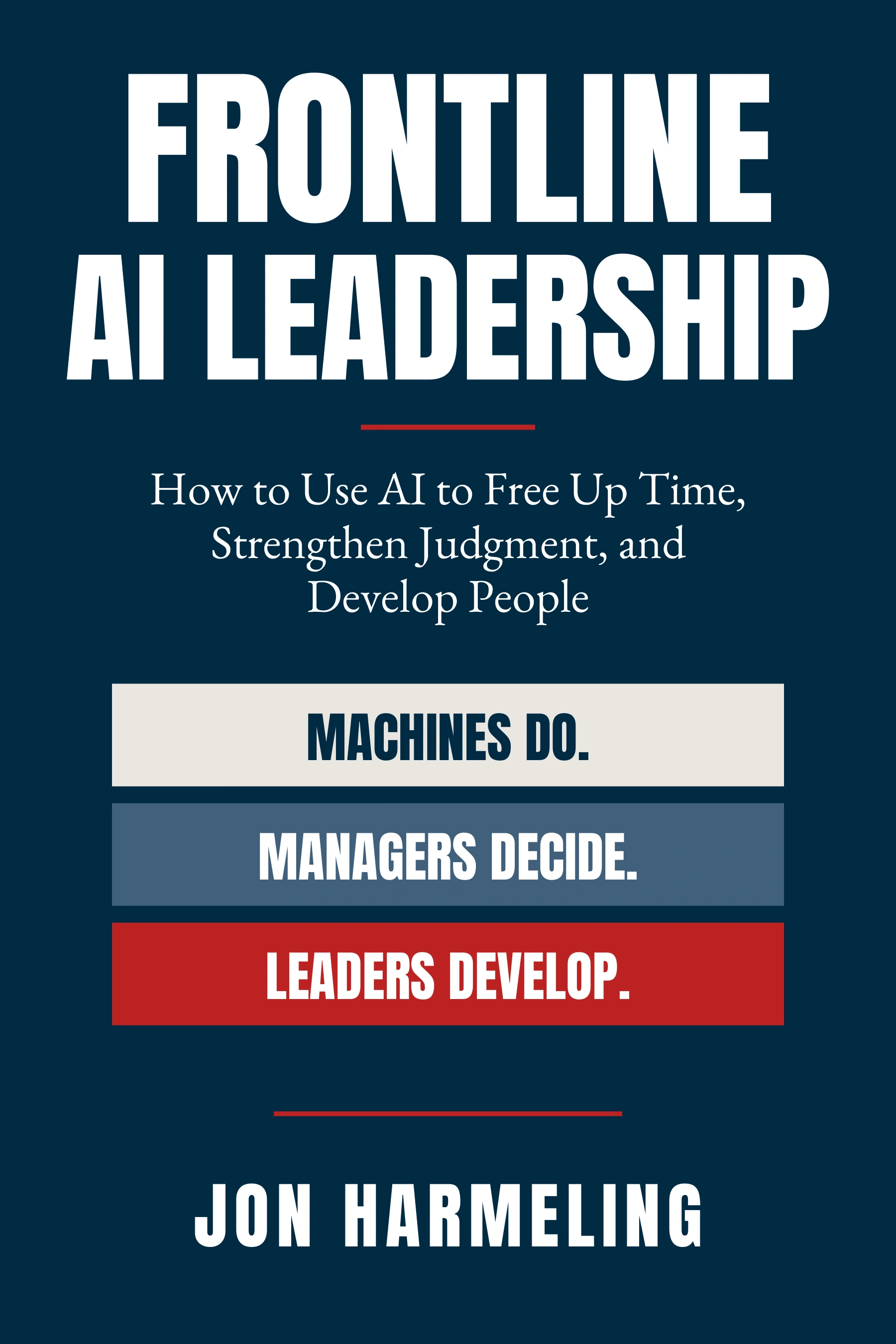
How to Use AI to Free Up Time, Strengthen Judgment, and Develop People. The book explains the frameworks and the human decisions behind every prompt on this page.
Signed paperback preorder, $16.99. Launches October 27, 2026.
100% of net proceeds from every book sale go to the team members Jon leads.
A practical keynote about using AI to remove work, improve judgment, and reinvest human capacity in better leadership, built from real operating stories for restaurant, franchise, hospitality, and retail leaders.
15% off when two or more paid events are booked together. A 30-minute preparation call and audience-specific customization are included. One 30-minute virtual follow-up within 60 days of the event is included in both standard paid in-person and virtual keynotes.
Start here the week after the event.
Use when: The week after you hear Jon speak.
I just heard about Frontline AI Leadership. Help me turn it into action this week: identify one person whose growth I can support (by role), prepare one important conversation, make one leadership commitment, and set a date to follow through. Ask me questions first, then give me a one-paragraph plan I can put on my calendar.
Data check: Roles or initials only. Book: Ch. 12, 13
Last updated : added the Shift-Ready Pack, the Frontline AI Data Rule, named frameworks, and the chapter-by-chapter companion to the book.
The standard stays the same: Machines do. Managers decide. Leaders develop.
A practical keynote about using AI to remove work, improve judgment, and reinvest human capacity in better leadership.